Simulation-ready 3D assets for physical AI.
USD objects and scenes that reference straight onto an Isaac Sim stage, with predicted PBR materials from a model trained on measured real-world data, and physics properties: mass, friction and restitution.
Measured Data In, Predicted PBR Out
Marso Measure captures PBR values from physical objects with a collocated camera and flash. That measured data trains I2M, our image-to-material model, which textures every asset in the pack.
Every material I2M produces is a prediction. What makes it a good one is its training set: measured reflectance, rather than values estimated from photographs or set by hand.
I2M
- Measured at sourceMarso Measure captures a BRDF lobe from a physical object using a collocated camera and flash, returning diffuse, roughness, specular, specular tint and metallic.
- A measured training setEvery capture is added to the I2M training set. Measurement enters the pipeline at this stage and no other.
- Predicted material stackI2M predicts albedo, metallic, roughness and IOR for a single mesh, or for every object in a generated scene, in minutes.
- Delivered as USDMetre-scaled geometry with the materials bound and the physics set, ready to reference directly from an Isaac Sim stage.
The same room, running in Isaac Sim
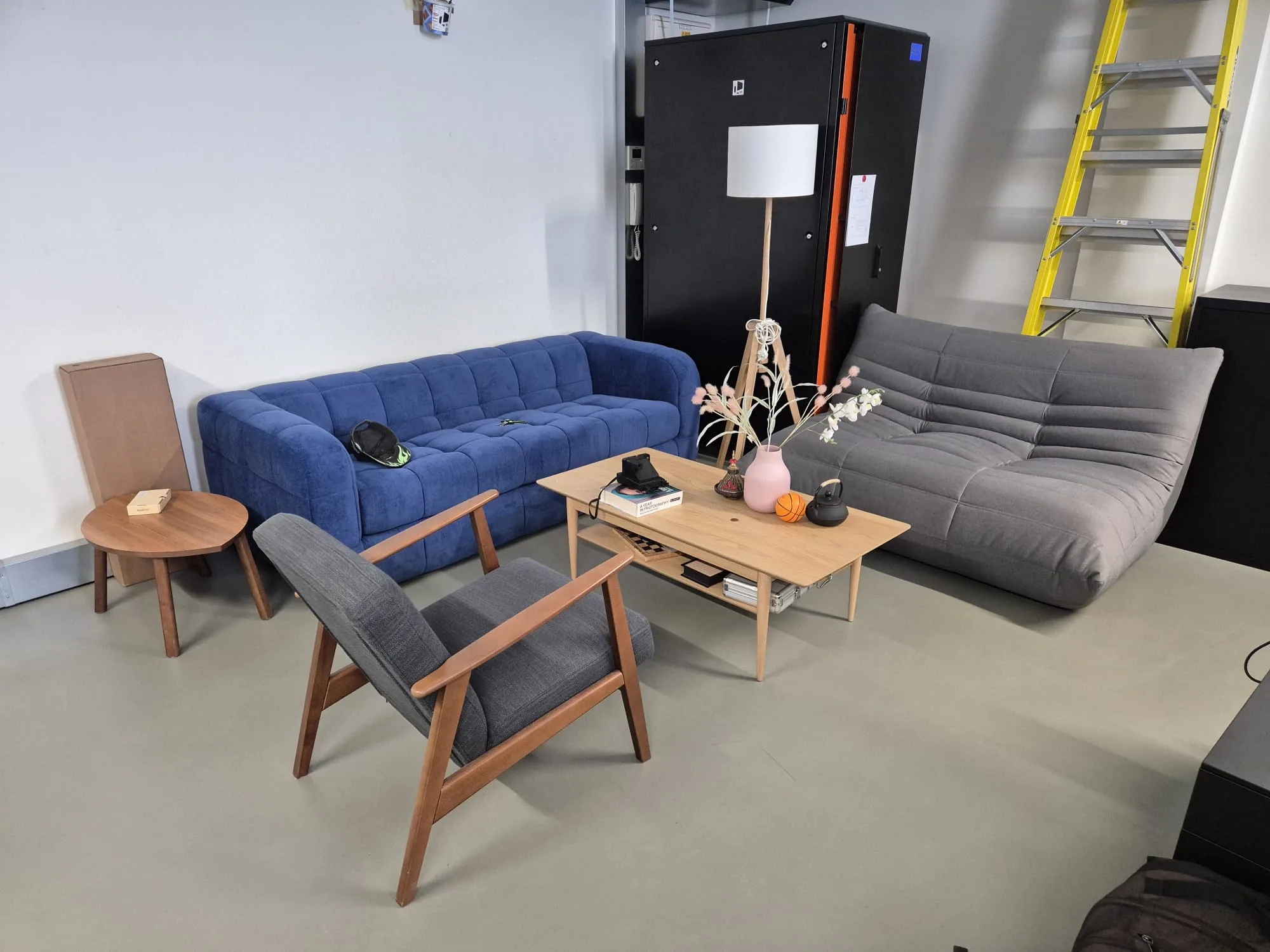
Drag to compare. Our office on one side, and on the other the same room in Isaac Sim. Every object carries a predicted PBR material and the physics inferred from it, so it falls, rolls and settles the way the real one does.
From single assets to whole environments
We work with a small number of robotics and simulation teams as design partners. You bring the training problems and candid results, and we bring the model, the pipeline and a say in where both go next.
Assets sourced from a dozen places, materials that do not match between them, and formats to convert before anything reaches the engine. It does not scale to the number of environments training needs.
We work through the environments your policies need, and find where the pipeline already holds and where it does not.
Studio decomposes a prompt into objects, builds a mesh for each one and textures them all with I2M. One model textures every object, so the materials agree across the scene.
Metre-scaled USD with materials bound, straight into Isaac Sim or your own stack, and a new environment whenever an experiment needs one.
Get The Asset Packs
Two packs of USD objects, each with predicted PBR at 2K and 4K and every object carrying mass, friction and restitution. One ships SDF colliders and one CoACD, so you can take whichever your physics pipeline expects, or both.
Your simulation domain informs what we capture next.
FAQ
What teams ask before they take the packs.
Two packs of USD objects. Every object carries a predicted PBR stack at 2K and 4K, made up of albedo, metallic, roughness and IOR, on metre-scaled geometry with the materials bound and mass and density, static friction, dynamic friction and restitution set. Both packs ship with import notes for Isaac Sim and Blender.
Mass and density, static friction, dynamic friction and restitution, set on every object, alongside the collider representation its pack ships. They are inferred from the material Studio predicts for each object, so what a thing is made of is what decides how it behaves when a policy pushes it.
The collision representation. One ships SDF colliders and the other a CoACD convex decomposition, so you can take whichever your physics pipeline already expects rather than converting on arrival.
Predicted. I2M produces every material in the packs. What makes a prediction a good one is what the model learned from: Marso Measure captures measured PBR values from real objects with a collocated camera and flash, and that measured data is the training set. Measured describes the capture and the training set, never the output.
Yes. Everything is USD, metre-scaled, with the materials bound and the physics set, so you reference it from the stage rather than rebuilding it. The same files open in Blender, and both packs carry import notes for each.
The packs are free. What we ask for is your details and what you are simulating, because that is what decides which environments we build and capture next.